Case Studies
Shopify Migration Without Losing Rankings
Client: International custom leather ecommerce brand — multi-storefront, 7-figure revenue
Role: SEO Channel Manager
Scope: Custom platform → Shopify migration across all storefronts, 2023–2024
The stakes
Site migrations are where SEO careers go to die. The industry data is consistent: most replatforms lose 20–40% of organic traffic in the months after launch, and some never recover. This brand’s organic channel drove a third of a 7-figure revenue base — a botched migration would have been a six-figure mistake.
The complication: this wasn’t one site. It was a portfolio of regional storefronts on a custom platform, each with its own URL structures, hreflang relationships, and ranking equity built over years.
(For the platform decision itself — why Shopify over staying custom or moving to WooCommerce — I’ve written about that comparison separately: Shopify vs Woocommerce.)
The method
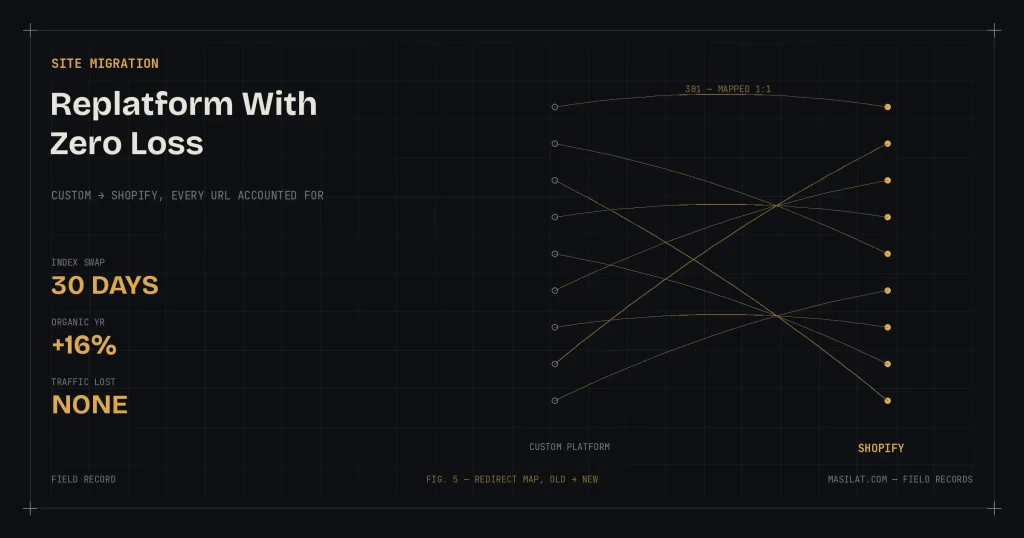
1. URL mapping at scale. The unglamorous heart of every migration. I built the full old-URL → new-URL mapping in Google Sheets, using Apps Script to automate the matching, pattern transformations, and validation checks that would have been impossible manually across the full URL inventory. Every legacy URL got an explicit destination — no wildcard shortcuts, no “redirect everything to the homepage” laziness.
2. Staged rollout, 2023 → 2024. Regional storefronts moved first in 2023 — smaller blast radius, and every issue found there became a checklist item for the main event. The primary site migrated in 2024 with the playbook already battle-tested.
3. hreflang re-implementation. Multi-regional stores live and die by hreflang. The entire cluster was re-implemented on Shopify and validated, so Google never lost the relationship map between regional variants.
4. Tracking continuity. Google Ads conversion tracking and analytics were rebuilt at cutover — because a migration that preserves rankings but breaks measurement still blinds the business.
5. Daily Search Console monitoring post-launch. For weeks after each cutover: daily review of coverage reports, crawl errors, and redirect behavior, with same-day fixes. Migration success isn’t decided on launch day — it’s decided in the 30 days after.
The results
- Google replaced the old URLs with the new Shopify URLs in its index within 30 days of cutover — exceptionally fast for a site of this size.
- Organic sessions grew 16% during the migration year (596K → 693K). Not “minimized losses” — grew. Against an industry norm of double-digit traffic loss, that is the strongest outcome a migration can produce.
- Additional regional storefronts launched on the new platform immediately after, on infrastructure that could finally support expansion — ultimately reaching 36 storefronts.
The takeaway
Migrations don’t fail because of the platform. They fail because of skipped fundamentals: incomplete URL mapping, missing redirects, broken hreflang, and nobody watching Search Console after launch. The work is tedious, spreadsheet-heavy, and absolutely decisive. If your migration plan fits on one page, you don’t have a migration plan.