SEO
How to Read a Google Patent Without Over-Claiming
A Google patent tells you what Google’s engineers thought was worth protecting. It does not tell you what Google runs today. A lot of patent-based SEO advice goes wrong in the gap between those two sentences.
I learned how wide that gap is from my own work. I built a research library from Bill Slawski’s SEO by the Sea archive, sorted into topic notes, with a verification log that checks patent details against Google Patents. Then I checked my four SEO playbooks against it. The weakest part of them was the patents. The best way to show why starts with a patent from 2003.
The domain registration story
In 2003 Google filed a patent called “Information retrieval based on historical data” (US 7,346,839, granted 2008). Its ten inventors included Jeff Dean, Paul Haahr and Matt Cutts, who led Google’s webspam team.
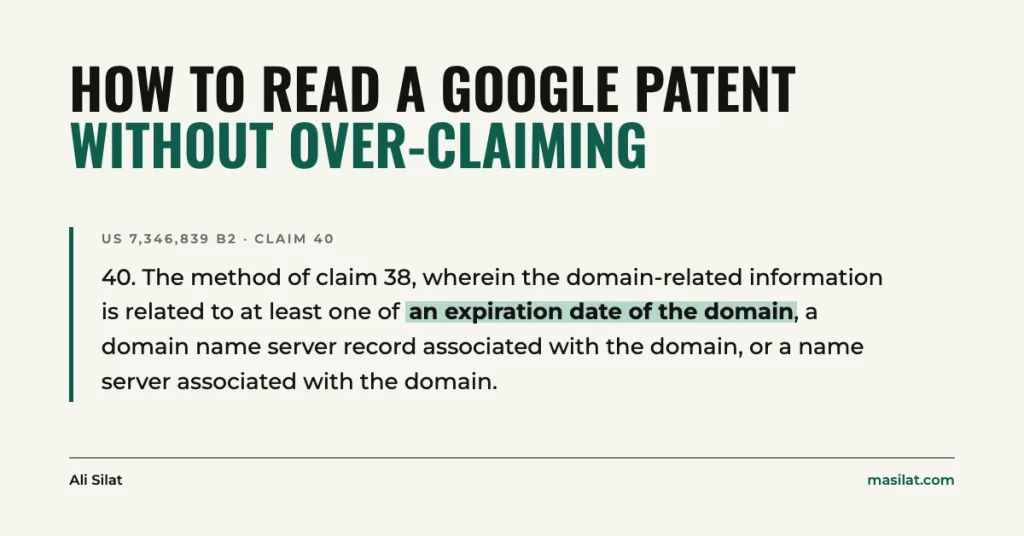
The description, the long explanatory part of the patent, suggested that a domain’s expiry date might help separate spam sites from legitimate ones: “Valuable (legitimate) domains are often paid for several years in advance, while doorway (illegitimate) domains rarely are used for more than a year.” The idea also made it into the claims, the numbered part that defines what the patent protects. Claim 40 lists “an expiration date of the domain” as one kind of domain data a score can be based on, next to DNS records and name servers.
In short: the patent hinted that a domain paid for years ahead looks more legitimate than one that expires next year. From there it’s a short step to “older domains rank better.” Nobody has shown that Google uses it, and the patent is from 2003. Plenty of SEOs still say aged domains work for them, and there’s a whole market for expired domains built on that belief.
Cutts rebuffed the idea more than once after the patent was published, according to Bill Slawski, who followed the story at the time. It did not matter. Hosting companies, GoDaddy among them, used the patent as a sales pitch to get people to register domains for longer. On 1 May 2013 Cutts published a video on SEO misconceptions and picked patents as his example, naming this one.
Bill replied within two weeks, in Avoiding Misinformation While Learning from Search Related Patents. He agreed with Cutts on the main point. He also pointed out something the sales pitch had skipped: the patent had produced more than a dozen continuation patents, and length of domain registration was not in the claims of any of them.
So the idea was in the description and in one claim of the original. That never showed Google used it, and the later filings left it out.
The same patent was in my own content playbook, marked “CONFIRMED”. Under it sat rules like “Age and accumulated history are assets” and “A brand-new page competing against a decade-old page is fighting a signal that cannot be shortcut.” The patent record was real. The rules were a reading of the description.
What a patent actually is
A patent is a trade. The inventor gets the right to stop others using the invention, and in exchange the invention is published for everyone to read. The World Intellectual Property Organization puts it this way: patents stop others from carrying out the invention, “but not from learning from the invention.”
It has two parts that people mix up. The description explains the problem and gives examples and alternatives, often a lot of them. The claims are the numbered sentences at the end, and they define what the patent protects. The description shows what the engineers considered. The claims show what Google asked to own. Neither shows what ships.
So a patent is a learning document. It shows what problem the engineers believed they had and one way they thought about solving it.
Five checks before you repeat a patent claim
These are the checks I now run before a patent goes into my notes or my advice. Several of them grew out of rules Bill followed for years.
- Granted or application? Many applications never get granted. An abandoned application is weak evidence of anything.
- Read the claims, not just the description. When I traced Google’s universal search patent, I found six US patents in one chain. The original was filed in 2003 and granted in 2008, then five continuations were granted in 2012, 2015, 2016, 2019 and 2022. A continuation keeps the original description and filing date. Only the claims change, so the claims show what Google kept protecting.
- Check the date and the owner. A 2005 filing describes a 2005 problem. The rank-modifying patent Cutts also named (US 8,244,722) was granted in 2012, but it continues an application filed in 2005. In seven years Google could have used it, tried it and replaced it, or never used it at all, and the record doesn’t say which. And check that the owner is Google, not IBM or a university.
- Has Google denied it or replaced it? The domain registration idea failed this check. Cutts had rebuffed it more than once, and hosting companies kept selling with it anyway.
- Is there a visible footprint? Some patents leave one. Bill wrote about a predictive search patent application in 2005, and Google Instant appeared about five years later. Others affect rankings without leaving a trace, and for those, as Bill put it, “it can be almost impossible to tell” whether they were used.
Three labels for every claim
In my research library every claim carries one of three labels.
- Confirmed: Google has stated or documented it, it is in sworn testimony or a court record, or anyone can reproduce it in the results. A leak or a court record can confirm that a system or an attribute exists. It does not confirm what that thing does or how much it counts. That part stays Interpretation until someone shows it.
- Patent proposal: a patent describes it. That shows the idea existed, not that it runs.
- Interpretation: someone’s reading, with the name of whoever is doing the reading.
The wording changes with the label. “Google has a patent describing X” is fine. “Google does X” needs a Confirmed source.
I found this harder than it sounds. In my content playbook, three patents were marked “CONFIRMED” because the patent record had been checked. The summary line then said: “Three are verified and act as rules.” The same file opened with the warning that a patent existing does not mean Google uses it. Checking that a patent exists confirms the patent, not the practice.
Why read them at all
Cutts was right that a patent is not “a golden truth”. But the fix for bad reading is better reading, not no reading. Bill put it well: “don’t take the existence of a patent as gospel, but also don’t automatically tune patents out.”
Patents show you the assumptions search engineers hold about searchers and the web. Continuations are a hint too. When Google keeps filing new claims on the same idea (five continuations for universal search, more than a dozen for the historical data patent), the idea probably mattered to someone inside. It still doesn’t show the idea runs.
The practical use is to turn a patent into a test, not a rule. My playbook had a test protocol: pick one page or a small set, change one thing, wait at least 4 to 8 weeks. The comparison showed why that isn’t enough. The rank-modifying patent describes a system that, when a page’s rank should change, may answer with “a time-based delay response, a negative response, a random response, and/or an unexpected response”. Nobody has shown Google runs it. My read is that if anything like it runs, a one-page before-and-after test can’t separate your change from Google’s own noise.
So state what you would expect to see if Google used the idea, change one thing on several pages, keep a matched set unchanged, and compare both over the same period. If the result holds, you have evidence for your own site. If it does not, you have saved yourself from repeating a domain registration story of your own.