SEO
How Google Scores Exact Match Domains: The Site Quality Score Patent: US9031929B1
There is a Google patent called Site Quality Score. Number US9031929B1. Inventors April Lehman and Navneet Panda. Google owns it. It is still active.
I read it last week. Took me three tries. Patents are written to be broad and hard to pin down, not to be understood. So here is the plain version.
Google watches two things about your site.
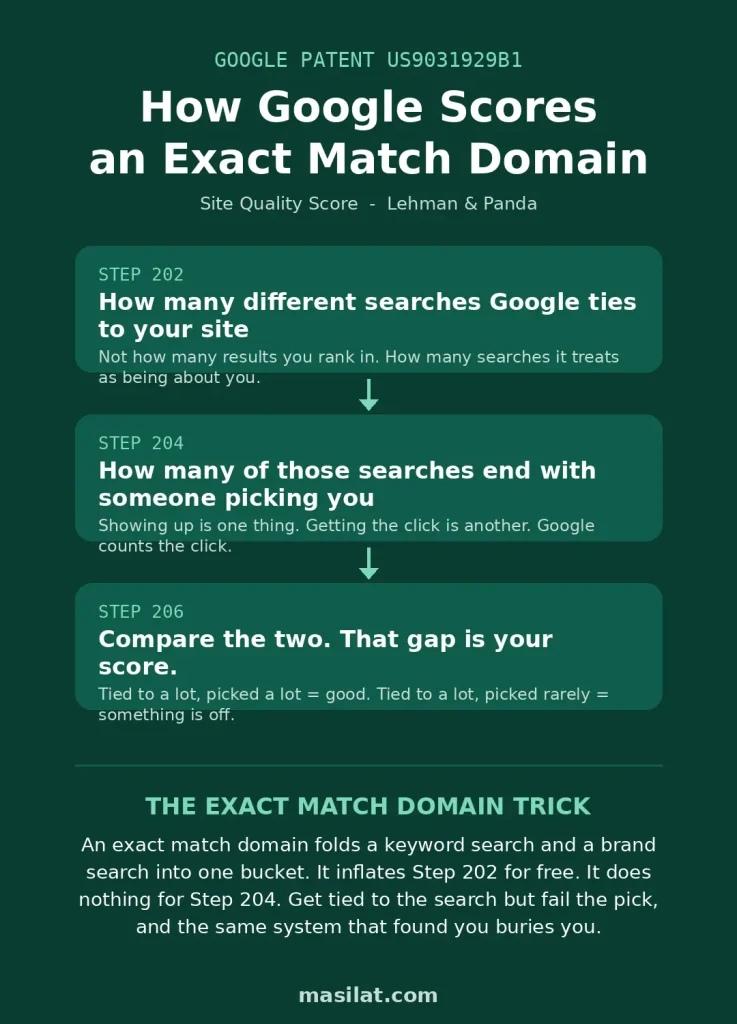
One. It counts how many different searches it ties to you. Not how many results you rank in. How many searches it treats as being about you. For a normal brand, that is people searching your name.
Two. It counts how many of those searches end with someone picking you. Showing up is one thing. Getting chosen is another. Google counts the choosing.
Then it compares the two. Lots of searches tied to you and lots of picks, good site. Lots of searches tied to you and almost no picks, something is off. That compare is your score.
That is the whole patent. Tied to you, versus picked by people.
Here is a simple example. Two shops sit on the same street. People walk past both all day, so both get noticed the same amount. One shop, people walk in and buy. The other shop, people glance and keep walking. Same foot traffic. Very different result. Google watches the walking in, not the walking past.
Now the part for exact match domains.
The first number is usually your brand. People search your company name, Google ties it to you. An exact match domain bends this. Someone searches “gold to tola price.” Plain topic search. You own goldtotolaprice.com. Google can’t cleanly tell if they want the topic or they want you. Same words. So that plain search starts getting tied to your site, like a brand search would.
You get the first number for free.
This is why exact match domains still matter. They were never dead. People just don’t know how to use them. The domain does one real thing. It folds a keyword search and a brand search into the same bucket.
But the patent sets a trap.
The first number is not the score. The score is the first number against the second. Getting tied to a search is half. Getting picked is the other half. So your domain shows up for the keyword. Good. If the page is thin and nobody clicks, now you own a site that comes up all the time and rarely gets chosen. To Google that reads worse than a site nobody ties to anything.
The trick that got you noticed for free turns into the thing that exposes you.
This is the same math that wiped out junk exact match domains years ago. They showed up. Nobody picked them. The signal flipped on them.
There is one more thing worth checking. What about people who click you, then bounce back to the results and pick someone else?
Read the patent line again. It counts a search as a pick when the user selects a result that points to your site. It counts the click. It says nothing about the person coming back. So by this patent alone, that bounce-back still counts as a pick. That is a blind spot in this one document. Google has other signals for the return-to-search behavior. This patent does not measure it.
So the real point is not “exact match domains are back.” They were always here. The keyword in your domain only decides which searches get attached to you. The click decides if that attachment helps you or sinks you. Get attached and earn the pick, you win. Get attached and fail the pick, the same system that found you buries you.
The domain is the setup. The click is the payoff. People chase the setup and forget the payoff.